
Deployment Metabolism: Mapping Constraints to Strategy
A framework for diagnosing your five deployment forces and understanding how constraints determine which strategic approaches can work.
When Revolutionary Launch Beats Gradual Deployment
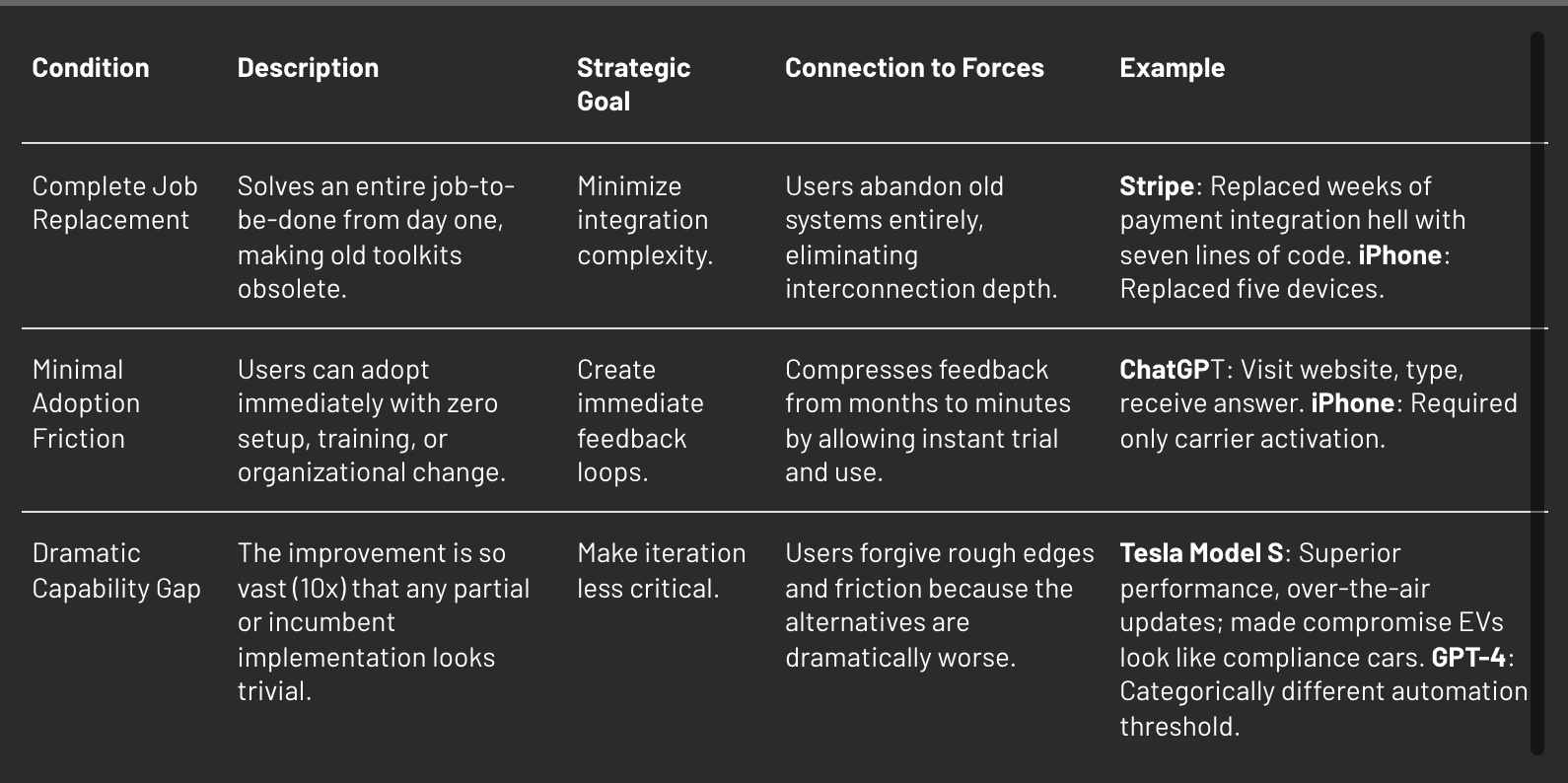
Revolutionary launch succeeds under three specific conditions. If you meet all three simultaneously, step functions beat ramp functions:
-
Complete Job Replacement: The system solves an entire job-to-be-done from day one, making old toolkits obsolete. The iPhone replaced phone, iPod, camera, GPS, and handheld computer. Stripe replaced weeks of payment integration with seven lines of code. Complete replacement minimises interconnection with existing systems.
-
Minimal Adoption Friction: Users can adopt immediately without training, integration, or organisational change. ChatGPT required zero setup: visit website, type question, receive answer. Zero-friction adoption compresses feedback from months to minutes.
-
Dramatic Capability Gap: The improvement is so vast that partial implementations look trivial. Tesla Model S didn’t offer “electric with decent range” but 0-60 in 3.2 seconds plus over-the-air updates plus autopilot. GPT-3 to GPT-4 crossed thresholds where entire categories of knowledge work became automatable.
When do these conditions align? Rarely. Most B2B products cannot achieve zero friction (they require integration). Most improvements are incremental, not 10x. Most jobs involve workflows, not single actions.
From Deliberate Planning to Constraint-Aware Discovery
Most AI deployments don’t meet the revolutionary launch criteria. For complex systems requiring integration, organisational adoption, or addressing jobs-to-be-done that involve workflows rather than single actions, the question becomes: how do you deploy strategically when you can’t simply launch and scale? The answer lies in understanding your constraint profile.
The core insight: constraints don’t just slow deployment; they fundamentally determine which strategic approaches can work. When your environment changes faster than you can plan, or when feedback teaches you more than analysis, the constraint profile becomes your strategic compass. Organisations that ignore their constraints attempt strategies that physics forbids. Those that understand their constraints maximize learning velocity within the boundaries they actually face.
Why Constraints Determine Strategy
Andy Grove’s “Only the Paranoid Survive” describes strategic inflection points, moments when “the basis of competition changes and the old rules no longer apply.” Intel had to abandon memory chips, their founding business, for microprocessors. The company that planned everything nearly died because they couldn’t plan for this.
Grove’s revelation: at certain moments, the environment changes faster than strategy can adapt.
Here’s the straightforward math: when iteration costs less than planning, the optimal approach flips. Traditional strategy says analyse, plan, then execute. But what happens when a two-week sprint teaches you more than a one-month analysis? You execute to learn what to plan.
Henry Mintzberg distinguished in “The Rise and Fall of Strategic Planning” between deliberate and emergent strategy. Deliberate strategies realise intentions (you plan and execute). Emergent strategies realise patterns (you act and learn). His radical claim: “In an unpredictable world, strategy cannot be planned. It must emerge.”
Eric von Hippel’s research revealed that innovations very often come from users, not manufacturers. Lead users don’t merely adopt products; they reveal what products should become. Nathan Rosenberg showed that innovation rarely follows its designers’ intentions. Technologies evolve through “learning by using,” as real deployment exposes new functions and applications.
The military discovered this through brutal necessity: no plan survives contact with the enemy. John Boyd’s OODA Loop (Observe, Orient, Decide, Act) revealed that the side cycling fastest wins, regardless of equipment superiority. Speed of adaptation beats quality of planning.
General Stanley McChrystal faced this in Iraq against insurgent networks that adapted faster than military hierarchies could plan. His solution: transform from hierarchy executing plans to network discovering patterns. “The temptation to control from the top is powerful, but the world has become too complex,” he wrote in Team of Teams. At sufficient complexity, centralised planning fails.
Silicon Valley internalised these military lessons and developed “north-star” and “principles”: setting clear direction and values within which teams can experiment freely. Jeff Bezos articulated it: “Be stubborn on vision, flexible on details.”
Steve Blank formalised this into Customer Development methodology: No business plan survives first contact with customers. The process became: Problem-Solution Fit -> Product-Market Fit -> Scale. Each stage discovers requirements for the next.
The Five Strategic Forces: Your Deployment Metabolism
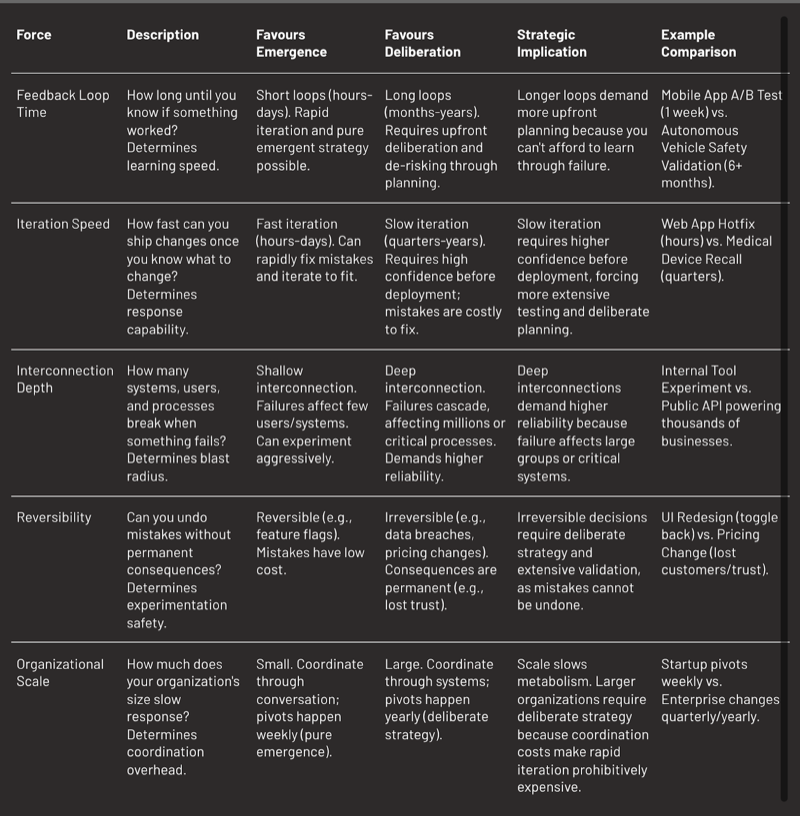
Emergent strategy isn’t abandoning planning. It’s recognizing when planning fails and maximising learning velocity within your constraints. Through analysing deployment patterns across dozens of companies, we hypothesise five parameters capture the primary constraints for understanding “strategic metabolism”, like biological metabolism determines how quickly organisms convert resources to energy and growth, these forces determine how quickly organisations convert execution into learning and adaptation:
-
Feedback Loop Time: How long until you know if something worked? Consumer apps get feedback in hours. Medical devices take months. Regulatory approvals take years. Faster feedback enables faster learning.
-
Iteration Speed: How fast can you try again? Software can deploy daily. Hardware requires manufacturing runs. Drug trials take years between iterations. Faster iteration compounds learning.
-
Interconnection Depth: How many things break when you fail? Standalone features fail gracefully. Platform changes cascade. Infrastructure failures paralyze dependent systems. Shallow interconnections enable experimentation.
-
Reversibility: Can you undo mistakes? Software can roll back. Committed capital can’t be recovered. Damaged trust takes years to rebuild. High reversibility permits risk-taking.
-
Organisational Scale: How much does size slow response? Small teams move fast. Large organisations coordinate slowly. Established brands face legacy constraints. Small scale enables agility.
Note: These five are proposed as a minimal useful set. They are not perfectly orthogonal (scale creates interconnections). Alternative taxonomies might emphasise different dimensions. This framework captures primary constraints in scenarios analysed, but invites refinement.
How Constraints Combine: The Strategic Landscape
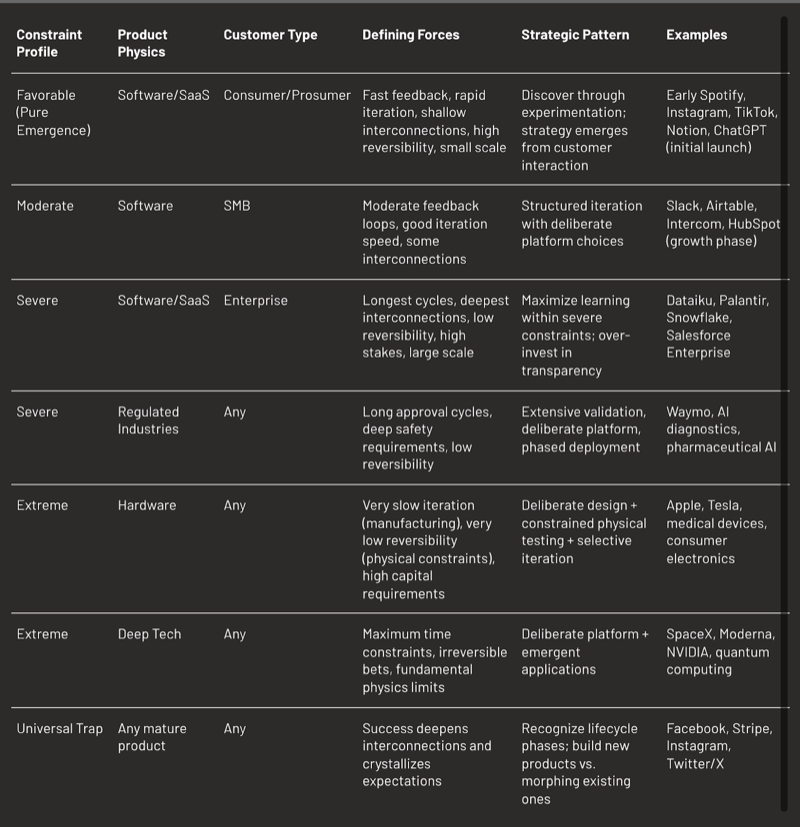
These forces combine across three analytically distinct (though interdependent) dimensions to create your complete constraint profile:
-
Product Physics (what you’re building): Software offers favourable iteration; hardware adds manufacturing constraints; regulated industries face approval cycles; deep tech confronts fundamental physics limits.
-
Customer Archetype (who you’re selling to): Consumers provide fast feedback; SMBs balance speed with complexity; enterprises impose maximum organisational constraints.
-
Lifecycle Stage (your maturity): Early-stage companies enjoy agility; growth-stage companies optimise; mature companies face rigidity from success itself.
These dimensions interact: enterprise customers often demand different product physics (audit trails, determinism, compliance features). Scale changes both product architecture and customer dynamics.
Three Extreme Constraint Profiles
Context 1: The Deep Tech Paradox
Constraint profile: Long feedback loops + slow iteration + deep interconnections + low reversibility
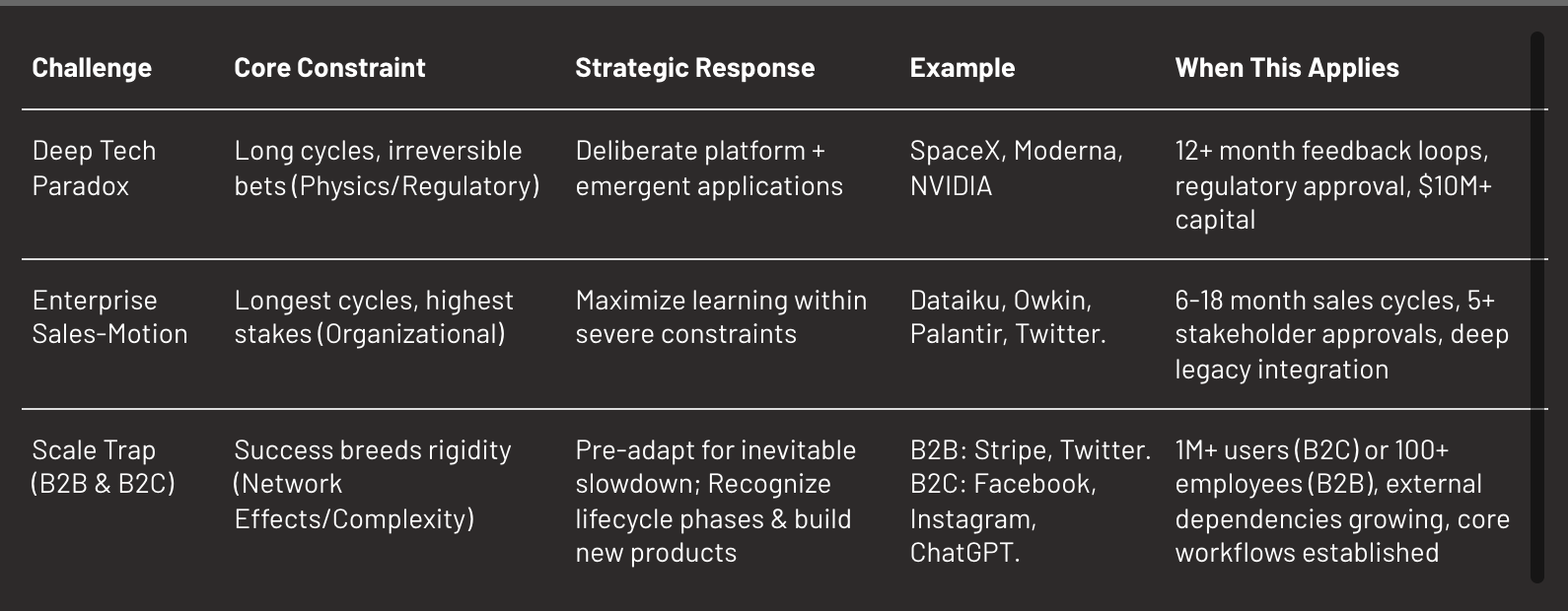
Deep tech requires deliberate strategy: long cycles, high capital, irreversible decisions, regulatory paths. Yet within these constraints, deep tech companies compress iteration wherever physics allows.
SpaceX illustrates how constraints operate at different organisational levels simultaneously. At the mission architecture level: deep tech paradox dominates (Mars mission requires 20-year planning, orbital mechanics are immutable). At the vehicle development level: compressed iteration within those constraints (Starship prototypes explode weekly to accelerate learning). Different subsystems face different constraint profiles. The art is identifying which constraints bind at which level of the hierarchy.
NVIDIA demonstrates strategic optionality within deliberate architectural choices. They committed to parallel processing architecture in the 1990s, not knowing which applications would emerge. The architecture created multiple potential futures: gaming, scientific computing, cryptocurrency, machine learning. When AI emerged as dominant, NVIDIA seized the opportunity their architecture had positioned them for.
The strategy for deep tech: Create deliberate frameworks that enable emergent discovery. Plan the platform (the physics, core technology, regulatory path). Discover the applications (fast experiments within the framework). Accept constraints you can’t change, maximize learning velocity within them.
Context 2: The Enterprise Sales-Motion Constraint Profile
Constraint profile: Longest feedback loops + deepest interconnections + lowest reversibility + highest stakes
B2B AI with enterprise sales faces uniquely challenging constraints: procurement takes 6-18 months, integration touches decades of legacy infrastructure, switching costs become prohibitive once data flows through your system, regulatory violations carry eight-figure fines, and adoption requires buy-in from legal, IT, compliance, security, procurement, and end users, each with veto power.
The constraint profile creates persistent friction between organisational purchase and individual adoption. This demands specific strategic responses: accept timeline compression limits, invest in transparency mechanisms (audit trails, explainability, source citations) that reduce perceived risk, design integration flexibility from the start (clean APIs, standard protocols), target single highest-pain lowest-risk use cases where value is immediate and failure manageable, and design for organisational learning across stakeholders, not just technical learning.
The pattern: Enterprise AI deployment is slow, but doesn’t have to be stuck. Match strategy to actual constraints rather than importing consumer product tactics.
Context 3: The Scale Trap
Constraint profile: Success transforms your forces (interconnection deepens, reversibility drops, scale increases).
Success itself systematically transforms your constraint profile regardless of business model. Three parameters shift unfavourably:
-
Expanding dependencies: Others build on your platform. Your API becomes someone’s business model.
-
Rising product complexity: You go from one feature to hundreds. Integration points multiply exponentially.
-
Escalating customer expectations: Early adopters forgive rough edges. Later customers demand perfection.
Over time, these forces compound and reach criticality, triggering a phase transition. The mechanism: scale increases interconnections geometrically while organisational capacity to manage them grows linearly at best.
Network effects create lock-in as users invest in learning your interface. Dependencies multiply as others build on your platform. Expectations rigidify as early adopters expecting experimentation are replaced by late majority demanding reliability. Coordination costs explode as changes require synchronizing more stakeholders.
In B2B: Twitter’s early API changes were harmless at small scale, but once thousands of companies depended on it, minor adjustments cascaded into ecosystem collapse. Enterprise customers intensify this: early B2B customers are sophisticated adopters willing to work through limitations. Later enterprise customers demand 99.999% uptime, SLAs, compliance certifications, dedicated support, legacy integration. Patrick Collison saw this early at Stripe: “We think about building infrastructure for the internet economy.” They pre-adapted for scale, rapid internal iteration but stable external interfaces.
In B2C: Consumer products often start with ideal constraints: fast feedback, rapid iteration, shallow interconnections, high reversibility, small teams. But success creates rigidity. Facebook pivoted constantly early (college network to photo sharing to news feed to timeline). After reaching a billion users, pivots stopped. Network effects and ingrained user mental models made change prohibitively expensive.
The Lifecycle Progression:
-
Early phase favours emergence: Discover what the product should be. Users are explorers who expect change.
-
Growth phase favours optimisation: Make the product excellent at what it is. Users want reliability.
-
Mature phase requires new products: Don’t force one product to be everything. Users have crystallised expectations that resist change.
The Response: Recognise which lifecycle phase you’re in and adapt strategy accordingly. Don’t pursue more agility at scale. Know when your core product has reached its natural endpoint. Facebook’s response: buy Instagram and WhatsApp rather than morphing Facebook itself. Build new products for new jobs rather than overloading existing ones.
Can organisations avoid the scale trap? W. Brian Arthur showed that scale can create increasing returns: network effects, learning effects, lock-in advantages. But these benefits compete with rising coordination costs. Amazon’s service-oriented architecture suggests intentional design can capture Arthur’s scale advantages while mitigating coordination costs through decoupled services and stable interfaces. The trap isn’t inevitable, but avoiding it requires strong architectural choices.
Understanding Your Multi-Dimensional Constraint Profile
Most companies face constraints across multiple dimensions simultaneously. A biotech company selling to hospitals faces Deep Tech Paradox (biology is slow) + Enterprise Sales-Motion (hospital procurement is complex) + potentially Scale Trap (if successful). Each dimension restricts your strategic options. The art is identifying ALL dimensions you operate within, then maximising learning velocity at their intersection.
What This Means for Your Deployment Strategy
The pattern that emerges across all three contexts reveals a unifying principle: constraint profile honesty enables optimised strategy.
Three diagnostic steps determine your path forward:
1. Assess your five forces accurately: Feedback loop time, iteration speed, interconnection depth, reversibility, organisational scale. Most teams overestimate iteration speed and underestimate interconnections, leading to strategies that can’t work given actual constraints. They import tactics from companies with different physics, mimicking consumer playbooks while facing enterprise constraints, or attempting emergence strategies while trapped in deep tech timescales.
2. Identify which dimensions constrain you: Product physics, customer archetype, lifecycle stage. Strategies that work in one dimension fail when multiple dimensions constrain simultaneously. The art is identifying ALL dimensions you operate within, then maximising learning velocity at their intersection rather than pretending constraints don’t exist.
3. Design trust architecture for your specific constraints: Build transparency, control, and progressive capability from the start. Source citations, confidence calibration, audit trails, explainability aren’t features to add later but foundations that permit deployment while trust accumulates.
Self-deception at any stage creates strategy failure regardless of technical capability. The organisations that shape AI’s future won’t be those with the best models but those who master integrated deployment strategy: honest about constraints, sophisticated about how constraints combine, deliberate about building trust within the physics they actually face rather than the physics they wish they had.
The Path Forward
Understanding your constraint profile transforms deployment from guesswork to strategic diagnosis. The five forces reveal your deployment metabolism, the three dimensions show how constraints compound, and the extreme profiles demonstrate strategies for maximum stress scenarios.
But constraint diagnosis only matters because deployment strategy determines whether AI capabilities reach the practitioners who can use them. The printing press required literacy programs, not just better printing. AI requires trust-building mechanisms that work through iteration with real users. As foundation models converge toward similar capabilities, competitive advantage shifts to those who master the full deployment stack: understanding why gradual deployment works, diagnosing constraint profiles accurately, and executing systematically.
The deployment paradox resolves through strategic clarity, not technical superpower. Constraints aren’t obstacles to overcome but parameters to optimise within. Success comes from matching strategy to physics, building trust through iteration, and recognising that in complex systems, deployment matters as much as what is deployed.